By Scott Thompson
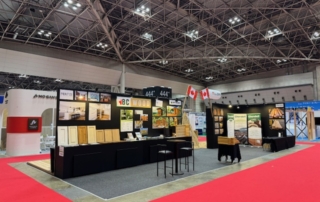
BUILDEX Vancouver, one of Canada’s largest tradeshow/conferences, welcomed over 13,000 design, construction, and real estate management professionals on February 13th and 14th to the Vancouver Convention Centre. Over 600 exhibitors and more than 50 educational seminars were presented to the interior design and architecture professions, property and real estate management, and the construction and renovation sectors.
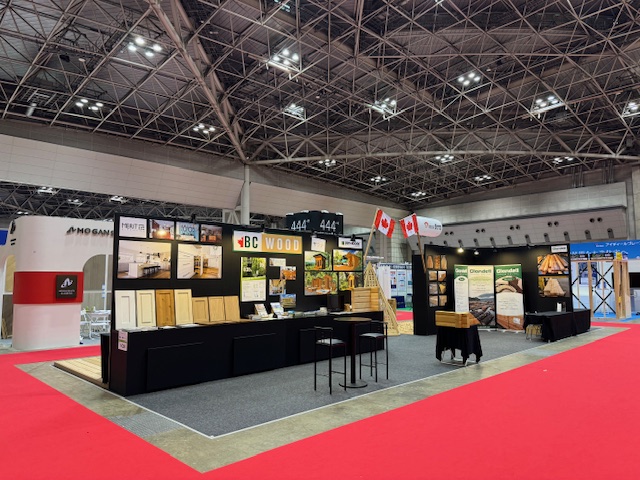
BC Wood coordinated a centralized area for wood products manufacturers with 15 members joining us from the building and finished products sectors including Structurlam, Sitka Log Homes, Pacific Homes, Cedarland, SilvaPanel, Coulson Manufacturing, Woodtone, Masonite, Kettle River Timberworks, BC Timber Frame, Merit Kitchens, Brisco Manufacturing, Big Foot Log Homes, AWMAC, and Wideplank Flooring. Feedback to date has been very positive with respondents citing renewed optimism in demand for wood based building products.
We were very busy during the show as we met with over 40 architects, designers, and contractors; approximately 20 of which we knew and were afforded the opportunity of renewing relationships. The rest were new connections who we will invite to future BC Wood specifier related activities including the popular lunch & learn sessions.
We met with 12 international buyers looking for BC wood products. In each case, we requested they contact us with detail that we can pass on to our members. To date, 3 have done this.
We also met with companies that were both exhibitors and visitors to the show from the value-added wood industry that are not BC Wood members and used the opportunity to promote various association activities.
BC Wood plans to participate in the next Buildex show being held Feb 18th – 19th, 2014. For more information on this event, contact Scott Thompson at 604-882-7100.
read more
A few comments and suggestions that may be of interest to industry…
The first few months of the calendar year proved to be extremely busy for the US program with our participation in the IBS show in Las Vegas which was immediately followed by the BIA Hawaii. While I admit there could be worse places to be in January than Vegas and Hawaii, having both events back to back provided a number of logistical and time challenges. The good news is that if you use these events as a barometer of market conditions in the US construction sector, then one could conclude that the market south of the border is finally getting better.
As discussed in the last edition of the Wood Connections, the IBS show has an impressive attendance, topping the 60,000 mark for the first time in five years. The same could be said for the Building Industry Hawaii (BIA Hawaii) trade event. While this regional event is small, interest and participation from the building community from across the Hawaiian Islands was strong. In fact, attendance at this years’ show was 20% higher than last year and up 45% over the past three years. Builders and other buyers who came by the booths were optimistic that market conditions were on the upswing and many were starting projects in the residential and light commercial construction sectors.
The Hawaiian market continues to be a prime location for BC grown softwood species including Douglas Fir, Western Red Cedar (WRC), and Yellow Cedar. This was evidenced by a site visit to a new development on the Big Island of Hawaii. This project is a high-end residential development of 40 plus homes anchored by a private beach club and golf course. More impressive than the view was the use of WRC and Douglas Fir in the construction of the residences and commercial buildings. WRC is featured extensively in the project including WRC shingles in the roof, 12’’clear board and baton exterior siding, and VG WRC interior panelling; the project was a showcase for the species. The architect specified WRC in part due to the unique colour and weather resistance properties of the wood. Where structural timbers were needed, Douglas Fir was specified and is prominently featured in the golf club house and beach club buildings. See images below.
This project is expected to last for the next four to six years. There is an opportunity for BC Wood members to supply materials and finished products for this project. In fact, with improving market conditions being experienced across the US construction sector, there remains excellent potential for the BC Industry to develop and grow market share through participation in trade events such as IBS and BIA Hawaii.
For more information on these events or other opportunities in the US market, please feel free to contact me at dfarley@bcwood.com
read more
In January, BC Wood participated with one of its member companies in the BAU fair in Munich, January 14th -19, 2013. While the turnout from BC Wood members was disappointing, the fair itself was probably the best show I have attended in two or three years. The BAU fair, held every two years, is the largest building materials trade event in Europe. Other shows, especially those in Asia, claim larger numbers; however, their numbers are pumped up based on the practice of allowing the general public access to the show. The BAU fair is a strictly trade-only event and this past event attracted over 240,000 visitors to the six day show.
The BAU fair has a strong international draw with over 60,000 of the attendees coming from countries outside Germany and the bordering Western European countries. This year saw strong contingents from Russia, Ukraine, Latvia, Estonia, Scandinavia, Turkey, Dubai, and other countries within the Middle East. The BAU fair lived up to its reputation as the “architects fair” with close to 50,000 attendees coming from architectural, planning and, design offices.
The size of the BAU fair is staggering with the 180,000 square meters of occupied exhibition space spread over 14 different exhibition halls that showcased the products and services of 2060 exhibitors. In total, 41 different countries where represented in the BAU exhibition halls. The halls were arranged by product categories. BC Wood was located in the “wood building systems” hall along with another 75-80 exhibitors. This arrangement works well as it tends to concentrate the buyers with a wood interest into two halls, ours and the one next door showcasing wood doors, windows, and flooring systems.
The traffic at the BC Wood booth was busy, many times a crowd two or three deep were in front or our booth waiting to talk to someone. This fact was a little astonishing considering that we did not have a display that was anywhere near as elaborate or as large as some of our neighbors. I think the fact that the Canadian flag was prominent and that we had a cross section from a cedar log home on display helped to pull the buyers in. People felt drawn to come into the booth to touch and smell the cedar. Many people did not even know the name of the species, but they did know that they liked it and the conversations started from there. I also think flying the “maple leaf” was important as our booth attracted a far higher proportion of attendees from outside of Germany. Almost 50% on the visitors to the BC Wood booth were from outside Germany. The vast majority of inquiries we responded to were related directly to Western Red Cedar and log home and timber frame projects. The market for these two product categories remains strong within Western Europe, but, particularly, in the new emerging markets of Central and Eastern Europe.
So, to say that I was impressed with the BAU fair and the level of interest that BC Wood received at the fair would be an understatement. I would urge BC Wood members manufacturing log, timber frame, pre-built homes, and any Western Red Cedar products to seriously consider participating in the BAU fair when it comes around again in January of 2015. For more background and some additional observation on the BAU fair, please do not hesitate to contact me at bhawrysh@bcwood.com.
The deadline for confirming space at the upcoming Turkeybuild show in Istanbul is fast approaching. For any company, who has not done so already, wanting to participate in the Turkeybuild show within the BC Wood pavilion, please contact Brian Hawrysh at bhawrysh@bcwood.com or in the office at 604-882-7100 by Thursday, Feb 28th, 2013.
For a little more background on the Turkeybuild show…
Turkey remains one of the strongest of these regional economies within Europe. Turkey also has a long history and affinity of building with wood, which gave way to a focus on concrete construction in the post WWII period. With their growing affluence, Turks are rediscovering their traditional preference for wood construction, particularly, in higher-end residential and recreational home construction.
For these reasons, BC Wood decided to explore opportunities for BC’s value-added sector in Turkey. Last May, four BC companies and BC Wood’s representative attended the Turkeybuild show and reported that there was very strong interest shown in BC’s products and services by the local timber and building materials distributors. The products generating the most interest were higher-end solid wood building products and interior finishing materials. Turkish companies showed a great deal of interest in partnering with Canadian companies that produce innovative, higher quality wood products.
During the period of April 24-28th, BC Wood will attend the Turkeybuild show in the country’s economic centre, Istanbul. Last year, the Istanbul show drew over 110,000 visitors, many of them from the neighboring Eastern European and Islamic countries. At Turkeybuild, exhibitors can showcase a full range of building materials and systems. High quality specialty lumber and building materials such as WRC decking, siding and roofing, log and timber frame homes, and prefabricated house packages will be of interest to the Turkish lumber importers, architects, and builders.
This week I had the opportunity to meet with a very interesting company; Vancouver Urban Timberworks. They specialize in producing products from hard and softwoods. What sets them apart is that their products are made from discarded trees around the local area.
In and around Metro Vancouver, there are hundredsof trees that are coming down for various reasons which could be quite costly for the individual or company to discard. Starting out in their North Vancouver driveway three years ago, Eric and Danny began retrieving these fallen trees free of charge. They then transformed these trees into unique wood products including large slabs, furniture, and other custom products.
One of their projects included producing a boardroom table made out of reclaimed and salvaged timber from the Squamish Valley in BC. After retrieving the tree, they reclaimed the usable timber, milled it into slabs, transported it in their biodiesel powered trucks, kiln dried it, CNC’d it flat, and finished the table. Click here to watch a quick video on the production of the table.
With the support of their community, they have moved their business out of the driveway and into a retail location that will soon house an exquisite showroom. They are steadily adding and upgrading their equipment and inventory to increase their capacity and meet a high demand.
For more information on Vancouver Urban Timberworks, visit their website: http://vancouverurbantimberworks.com and their facebook page: facebook.com/pages/Vancouver-Urban-Timberworks/245145348849853
read more
By Scott Buchholz
This past week saw BC Wood and FPInnovations sponsor a well-received traceability workshop attended by a wide range of industry manufacturers and related Forestry based associations. The workshop broached the subject of the potential role of traceability systems, like ThisForest, as a marketing tool and as an addition or alternative to certification.
With consumers becoming increasingly interested in the origins and supply chains involved in a product, traceability systems are seen as an effective marketing tool, showcasing sustainable business practices and the heart of the company itself.
Traceability represents this missing link between producer and consumer. The fishing and farming industries have already adopted traceability as a viable medium to this extent; it seems the Forestry sector is poised to adopt similar strategies given traceability’s growing popularity, both in industry and consumer demand.
Why is this good for your business?
Traceability is beneficial to business, big or small, for a number of reasons. International pressures are seeking proof of legal harvesting. For producers, this can be demonstrated through traceability, which tracks the supply chain back to the forest of origin. In addition, a company showcasing responsible business practice has the potential for financial return via an increased referral rate due to improved online presence through participation with ThisForest.
Traceability provides a bridge between company and consumer, whether B2B or B2C. It allows the consumer insight into the forest of origin where the wood was harvested, the story of the people behind the company, and something that can be shared between purchaser, family, and friends.
We all know word-of-mouth is the most effective tool in marketing. Studies show that people are more likely to purchase something that was recommended to them by a friend, than anything else. Traceability equips buyers with the tale behind the product and a more intimate relationship with that which was purchased. This motivates consumers to share the story of their purchase and proposes a greater likelihood of returning customers and referrals.
ThisForest is currently in its initial stages of development with a number of trial companies experiencing overall positive results. The workshop this past week allowed for industry input on this burgeoning field of traceability in combination with online marketing and social media. This mechanism doubles as not only a way of showcasing responsible Forestry practices, but also as an effective marketing strategy that people can relate to and share with their inner circles.
It is digitized word-of-mouth.
For further information please visit www.thisforest.info or contact Natalie@ecotrust.ca or myself at Sbuchholz@bcwood.com
read more
The industry has also launched a competition to give eight promising students across Canada a paid Green Dream Internship that includes a four month paid summer placement at a forest products company, an iPad Mini and a chance to win $5000.
“The forest products sector is now a future oriented business that is brimming with opportunity. It is now hiring and offering solid careers for those who care about their future, the environment and their quality of life,” said David Lindsay, President and CEO of FPAC, speaking at PAPTAC’s Annual Paper Week event held in Montreal.
Under Vision2020, FPAC has a set the goal of recruiting at least 60,000 or more workers by 2020 to meet the growing demand for such professions as millwrights, electricians, engineers, sales staff, truck drivers, foresters, chemists and many more.
“Our government’s top priorities are job creation, economic growth and long-term prosperity, so it is imperative that we match the skills of Canadians, especially younger workers, with the needs of the employers,” said the Honourable Diane Finley, Minister of Human Resources and Skills Development. ”Through our partnership with the forestry industry, we are helping young Canadians to receive the skills and training needed to address skills shortages in the forestry sector and prepare them for future careers.”
“We invite Canadians to visit the Greenest Workforce website to see the exciting opportunities now available. We also want to encourage students to consider applying for the internships to receive job training, skills development, and real-world experience within our growing sector,” says Lindsay.
The contest requires students to submit a short video explaining why they would be perfect for a Green Dream Internship. Applicants receiving the most votes for their video attempt will get on a short list for interviews for the paid summer positions.
The contest and voting period starts today and ends March 31, 2013. For more information, visit TheGreenestWorkforce.ca. You can find more information on FPAC’s Vision2020 at: www.fpac.ca/index.php/en/vision2020/

The housing starts for 2012 are in and are better than had been anticipated. Last year when the Japan Forest Journal surveyed 15 top home builders, the forecast for the year came in at 870,000. However, with starts rising 10% in December to total 75,944, the housing market for the year finished at an impressive 882,797 units. This was an increase of 5.8% over the previous year and also marked the third straight year of growth after the market began to recover from the Lehman Shock.
Demonstrating the soundness of this recovery, growth across all housing sectors continues to be seen. According to MLIT statistics, custom homes increased by 9.2%, rental units by 11.2%, and spec homes by 9.8%. Looking at the numbers by the type of wood construction method, we see that zairai grew by 6.3% to 31,840, 2×4 by 10.5% to 10,258, and wood pre-fab by 12.9% to 1,454.
Perhaps the best news for the Canadian lumber industry though was the fact that 2×4 starts were up 9.4% on the year to end at 107,487. This number is just shy of the record set in 2008 emphasizing the continuing strength and market penetration of the 2×4 system.
Going forward, high SPF prices and a weaker yen versus the dollar is creating some concerns. However, as all input prices in the Japanese construction industry are under pressure, this is not a problem unique to 2×4. In fact, wages of skilled labourers around Tokyo have jumped by as much as 40% due to the strong housing market combined with reconstruction work in Tohoku. The costs of materials such as concrete are even delaying reconstruction projects as budgets have been stretched.
Despite cost concerns, most of the industry people I have been speaking to since the beginning of the year are predicting a strong 2013. The major push continues to be the planned rise in the consumption tax in 2014, but favourable sentiment is now also being driven by the new Prime Minister’s economic policies. A similar survey of the 15 major builders for 2013 resulted in a projection of 920,000 starts. With the current positive climate in Japan it is quite likely that this forecast will also be easily surpassed.
Conference Board of Canada outlook puts Vancouver near top of municipal economies
British Columbia’s manufacturing and forestry industries should enjoy respectable growth in 2013, a new report from the Conference Board of Canada suggests. The board’s annual Metropolitan Outlook suggests a revitalization of the province’s shipbuilding industry should commence later this year as Vancouver Shipyard completes $200 million worth of infrastructure upgrades needed to accommodate an $8-billion contract to build seven new vessels for the Canadian Coast Guard. Work on two smaller vessels is expected to begin later this year.
“Right now it will be the construction (sector) that benefits,” board economist Greg Sutherland said in an interview. “Then you will see it more in transportation and manufacturing, once the construction finishes.”
The manufacturing sector will also benefit from a recovery in U.S. housing, the primary market for B.C. lumber. The board expects total manufacturing output to rise 3.6 per cent this year and 2.1 per cent in 2014.
However, within a couple of years, the forest sector will face ongoing supply constraints arising from the ongoing pine beetle infestation, the board warns.
“Supplies of salvageable pine beetle-infested wood will start to run out. This is expected to tip the industry into a downturn as it adjusts to the significant reduction of available timber,” the report said. Sutherland said the sector’s short-term prospects are better than many would expect.
“Housing starts in the U.S. have come back. Sometimes you wouldn’t know it if you watched the news but the data does show that they are building again, significantly, south of the border. So that increases the demand for B.C. lumber. But there is definitely a supply constraint because of the beetle, more in the medium term, but it’s coming.”
Overall, the board expects B.C. to achieve 2.7 per cent real GDP growth this year compared to 1.8 per cent in 2012, and then hold at 2.5 to 2.6 per cent per year through 2016.
read more
The Canadian Commission on Building and Fire Codes (CCBFC) is taking a closer look at requirements in the 2010 National Building and Fire Codes of Canada that currently limit the height of wood buildings to no more than four storeys. The initiative was undertaken as a result of code change requests from the Province of British Columbia and the Canadian Wood Council asking that the current height limits for combustible construction be increased. Doing so would move the National Model Construction Codes towards harmonization with various code development initiatives and market access policies being established in jurisdictions across the country.
A joint task group encompassing several CCBFC standing committees was established in 2011, led by the Standing Committee on Fire Protection, to review current requirements and make recommendations. Four specific areas were examined: fire protection (building elements); emergency response (fire code requirements); building and plumbing services; and structural and earthquake design.

The task group determined that height and area limits for buildings constructed of combustible materials could safely be increased to six storeys by either introducing new and/or modifying various protective measures. These proposed changes would apply to residential and office-type buildings (Groups C and D occupancies, respectively, in the Codes). They would also include mixed-type occupancies where Group C and D buildings, depending on the top occupancy, may have office, residential, mercantile, assembly, low hazard or storage garage-type occupancies (Group D, C, E, A2, F2, F3 respectively) on the lower levels.
Click here to read the entire article
read more
If you simply set up your trade show booth and collect business cards or scan badges of everybody coming by, you’ll get a lot of leads, but they won’t be very good leads. Sure, you might get a hot prospect or two, but you’ll burn through a lot of suspects along the way. Can you afford to spend that time?
Worse yet, you’ll miss those list-building attendees who never even made it to your part of the show floor.
The secret to generating higher-quality leads – as with any form of successful marketing – is to offer a highly relevant message to a highly targeted audience.
That starts with a creative message that compels your target audience to learn more about you. Ask a provocative question, make a challenging statement or suggest a different reality. But make sure to let your audience know that you understand their situation and have a solution that solves their problem. Remember, however, your goal with pre-show marketing is to earn a spot on the attendee’s must-see list. Nothing more. It’s not the time to share your company’s history, list every feature, share prices or ask for the sale.
Click here to read the entire article
The Large Wood Structures Symposium, held on February 20th at the Vancouver Convention Centre, started with a seminar entitled “Research to Help Push the Limit of Use of Mass Timber in Canada.”
Presented by NewBuildS! Scientific director Dr. Ying Hei Chui, the seminar delved into the many ways research is being implemented to tackle large wood builds.
Chui pointed out that in 1941, the national building code did not allow for wood structures above four storeys. Some European countries based their code on performance and not on arbitrary storey requirements, but Canada’s building code remained fixed on hard limits for wood structures.
Government is conducting a research program via the NRC construction portfolio to study the feasibility of large wood structures. But in the realm of industry-led research, a project to study mid-rise wood buildings is well underway.
FPInnovations has an Advanced Building Systems Program focusing on CLT (heavy timber.) Their program also touches on fire durability and sustainability.
Structures covered by the program include light frame, post and beam, CLT and hybrid.
Planned activities for 2013-2014 include a focus on sustainability, as well as studying building envelopes and creating a set of energy efficient building enclosure design guidelines.
Click here to read the entire article
read more
Steven Street spent some time this week in the Vancouver area, seeing with his own eyes what all the fuss and fear has been about.
The wood industry executive, along with a few Ontario engineers and architects, toured half a dozen new British Columbia condo developments.
On paper, the buildings might sound radical. But, in reality, they seemed to Street and others on the daylong excursion exactly what they were meant to be — nice, affordable places to live.
Until four years ago, these six-storey condo projects would have been built out of concrete and steel. But because of controversial amendments to the B.C. Building Code, which used to limit wood-frame construction to four storeys, they can now be built — more cheaply and quickly — out of wood.
“There are upwards of 170 of these buildings under construction out here. They’re nice-looking places. The people living in them seem generally very happy,” says Street via cellphone mid-tour.
“This isn’t about building cheap housing (that compromises safety). It’s about removing barriers to using materials other than plastic, steel, glass and concrete.”
Ontario’s Building Code restricts wood construction to buildings of four storeys or less. But for a number of reasons, developers here have been pushing to boost that number to six, like in B.C., where there’s now talk of going to eight or more storeys.
After a successful show in 2012, BC Wood returned to the MBC Show in Seoul, South Korea from January 25th to 28th. MBC is one of the largest construction shows in Korea with 312 exhibitors this year and over 170,000 visitors comprised of builders/architects (39%), interior designers (32%), manufacturers (6%), and distributors (4%) according to the organizers data. Products on display at the show included everything from structural materials and construction equipment to windows, doors, and finishing materials.
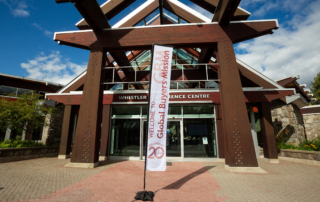
The Canadian pavilion was once again organized by BC Wood’s Korean representative, JC Lee. While there were other overseas exhibitors at the show, only the Canadian exhibitors enjoyed a branded pavilion. A total of six BC Wood members took part covering a variety of species and lumber products as well as kitchen cabinets and siding products. The BC Wood booth was used as a reception desk for clients coming for appointments as well as to disseminate information on Canadian wood products and recruit buyers for the September GBM.
As always, JC lined up meetings for the attending members with key clients. However, this year he also arranged an opening day reception inside the pavilion in order to create a networking opportunity for members with invited Korean wood industry VIPs. Both the BC Government Office in Seoul and the Canadian Embassy were partners in this event. Over 100 Korean clients attended this event.
BC Wood also organized an architect’s seminar on the day before the show in collaboration with KIA (the Korean Institute of Architects) in order to promote the use of Canadian wood products in commercial building projects and particularly for facilities being built for the Pyungchang Winter Olympic Games. The event was held at the historic Old Seoul Rail Station and was attended by close to 100 KIA members. Attendees were able to learn about the various wood solutions offered by Canada while we were also able to gain access to high-value specifiers and influencers in the Korean architectural community. BC Wood is planning to further develop this target segment by taking part in the KIA Convention this October. Please contact Jim Ivanoff (ivanoff@canadawood.jp ) or JC Lee (lee@canadawood.or.kr ) for more information on this upcoming event.


A few comments, suggestions, and ideas that may be of interest…

A few weeks back, BC Wood and a contingent of eight member companies travelled to Las Vegas to participate at the International Builders Show (IBS), an annual event where tens of thousands of suppliers, distributors, and builders convene to examine new innovations in home building materials, appliances, fixtures, and technologies.
The mood at this years’ event was optimistic, as construction of single family homes climbed 18% in December from the previous year. When measured year-to-year, home construction in the US is projected to be 23% higher than in 2011, which was a record low year. Strong housing starts along with pent up consumer demand created an air of renewed confidence at this year’s IBS.
IBS also sets the standard for manufacturers to unveil the latest in new and innovative construction products. Kohler, for example, introduced a Bluetooth enabled shower head that can instantly stream your music collection from your cell phone or tablet. Innovative wood products included stunning curved glass door systems from Nana Wall and Caoba door that take advantage of the Eclipse track system which allows the doors to be folded away allowing for large unobstructed openings of up to 20 feet.
The BC contingent, not to be overshadowed by their competitors, did an excellent job of showcasing their wares. Kettle Valley Millwork partnered with Norelco cabinets in the design and construction of a beautiful booth exhibiting their world-class cabinet and architectural millwork capabilities. One showstopper was Norelco’s “gun slinger” kitchen which featured a solid mesquite wood counter which was supported by 3 hand carved six shooter guns. Attendees were drawn to the unique look of the kitchen and at one point had a line up of 10 people to get into the booth.
Participating BC Wood members commented on the high quality leads that were created at the event. BC Wood member Canadian Timberframes Ltd. felt that they got over a 100 solid leads from builders and architects from across the United States and South America. All things considered, the 2013 IBS builders show was a barometer for showing that the US economy is improving and that the residential construction sector across the US is back on the right track. Initial optimism was abundant and here is hoping that this attitude now becomes the norm. For more information on the IBS show or the US market, please contact me at dfarley@bcwood.com

I’m a glass-half-full kind of guy, I believe, and I’m flexible, so I try to look at the positive opportunities in any situation. Small trade shows, therefore, aren’t a problem. In fact, they can be a powerful tool for the opportunistic trade show marketer.
Sure, you can go into the small show looking for problems, but a positive approach can get you more bang for your buck than many larger shows.
1. Small audience. Big connections. – Sure, the traffic might not be heavy throughout your show, but that lets you reach out to a few key contacts to schedule meetings. Fewer activities and a smaller show floor means they are likely to have fewer commitments if you can get on their calendars early. Make a compelling case and get the appointment in your trade show booth or before or after the exhibit hours.
Click here to read the entire article
read more
As mentioned in earlier Wood Connections, we anticipated that the first quarter of 2013 would be a busy for the Specifiers Program and the reality is indeed living up to expectations.
We started 2013 out with a bang as January was an incredibly busy month. We conducted 9 Lunch & Learn (L&L) sessions with architects in Vancouver and Surrey and booked additional sessions for February and March. Three of these sessions were initiated by the architects as they requested follow up lunch & learns on specific products we covered in our overview.
We also finalized 4 seminars; two of which are with the two major construction associations in Greater Vancouver – The Independent Construction Business Association (ICBA) and the Vancouver Regional Construction Association (VRCA). BC Wood will have 5 firms from industry actively participating in these sessions with each having approximately 20 minutes to educate the contractors on their respective products. We have also finalized plans for group seminars in Kamloops and Kelowna. These sessions are targeting architects and specifiers and once again BC Wood will be joined by representatives from our industry. This time, 4 companies will participate and present their products in an educational format to the respective groups. We are also planning on a couple of individual L&L sessions while in the Okanagan. All these sessions will be held in March with Kamloops and Kelowna scheduled for March 5th and 6th respectively, the VRCA scheduled for March 20th, and the ICBA scheduled for March 27th.
While we haven’t mentioned it yet, February will be no “cake walk”. As of now, we will have conducted 3 lunch & learn sessions, and are gearing up for Buildex which will be held on Wednesday and Thursday of this week. a week later, I am off to Seattle for the Wood Solutions Fair and returning for another lunch & learn session. Then the week after, we are off to the Interior for our previously mentioned seminars.
In the first weekend of February, I had the pleasure of speaking to the BC Log and Timber Builder Industry Association on the subject of Marketing to Architects. The occasion was the LTBIA’s 16th Annual Conference and AGM which was held at the Quaaout Lodge in Chase, BC. Although my stay was relatively short, I did have the opportunity to renew acquaintances and met some new friends from the LTBIA. From all reports, the conference was a great success so congratulations to Patti LeFrancois and Aaron Moore and their groups for organizing this successful event. I was happy to have been a small part of it.
It’s hard to believe but in just 6 (hectic) weeks, our fiscal year will come to an end and we will start gearing up for the 2013 – 2014 Specifiers Program. If you have any thoughts regarding changes or additions to the program, this would be a good time for your suggestions. We are very open to them as in the end, while we may administer the program, it can only be successful if industry is fully engaged with the ultimate goal of increasing industry’s business. So if you have any suggestions, please let us know.
Also, if you have any questions on this article or wish for more information on any aspect of the Specifier Program, please contact me at rmanion@bcwood.com or call the office. I would look forward to hearing from you.
read more
Dust collection is one of those issues for the small woodworking shop that cost money to operate and maintain, but doesn’t seem to add value to the product…or does it. Lacking dust collection or having inadequate dust collection can generate all sorts of problems if for example, you have a finishing booth. Without an appropriate dust collection system, fine dust particles will be drawn into the spray area either by the area’s exhaust system or by being stirred up by other movement in the shop. Wet coated surfaces are magnets for dust, and as a result product quality suffers and your finishing costs rise as you try to deal with fixing the problem at a later stage.
Small shops have two choices with regard to dust collection: a portable single stage dust collection system or a two-stage cyclone system. The single-stage systems are economical to acquire, simple to operate and being portable, they can be moved from wood working machine to machine as required. They have less loss of air velocity and volume as the blower unit is close to the source of chips, shavings and dust. However, they need adequate space to operate in and they have to be repositioned as required. The fan or impeller on these units does come into contact with dust or any other debris in the air stream which in turn may cause damage to the fan assembly. Such impacts can cause sparks and in the presence of dry, fine woody material, a fire could result.
Two-stage or centralized dust collection systems are more powerful and costly, but they can accommodate the dust collection needs of a number of machines simultaneously. A two stage system involves a cyclone to separate out coarse dust from the finer dust, followed by a filtering system or bag house to capture the fine dust. They are more often positioned outdoors thereby freeing up valuable floor space. With these systems the impeller does not come into contact with any of the debris drawn in but sparks can still occur in these systems especially in the ducting and the bag house.
A duct system is required to connect the machines to the dust collector. Ducting systems can be the downfall of any centralized system therefore careful design is required so that the dust collector position is optimized to the position of the machine it services. There are a number of factors that can influence the performance of these systems. For example, the machines being connected should be in close proximity to the dust collector and attached with ducting that contains a minimal number of corners and other joints. Using the optimal duct diameter size for each machine ensures sufficient air volume to provide effective dust collection and air velocity to move the dust along the duct without it settling into piles.
The decision between a single stage or a two stage dust collection system rests mainly with cost, space requirements, simplicity of operation and dust collection requirements. Contacting a local vendor of dust collection equipment is a good first step in making the final decision on which system to choose.
Good websites about dust collector basics can be found at http://billpentz.com and http://www.rockler.com/articles/getting-tough-on-dust.cfm. Alternatively, there are a number of companies that offer turnkey dust collection systems and services to assist companies in selecting the optimum sized units for their manufacturing needs.
For further information contact on this topic, contact Brian Ehrecke (250) 462-4000, brian.ehrecke@fpinnovations.ca
read more
The sawmills of three major Canadian lumber producers are expected to enjoy brisk orders this year, especially as housing markets in the United States perk up.
West Fraser Timber Co. Ltd., Canfor Corp. and International Forest Products Ltd., which report their fourth-quarter results this week, have regained their swagger during the long road to recovery over the past four years.
B.C. Interior sawmills operated by West Fraser, Canfor and Interfor are working their way through limited timber inventories that must be processed after mountain pine beetles decimated forests in the region, but there is an abundance of wood supply in the U.S. Southeast, said Mark Kennedy, an analyst with CIBC World Markets Inc.
Interfor will release its fourth-quarter earnings on Thursday, while West Fraser and Canfor will announce their financial results on Friday. Analysts forecast the three Vancouver-based companies will generate impressive margins for earnings before interest, taxes, depreciation and amortization (EBITDA) because lumber prices climbed sharply in the final quarter of 2012.
Click here to read the entire article
Growing demand from the U.S. housing markets has convinced Tolko Industries the time is right to reopen its Athabasca mill in Slave Lake.
The company is proceeding with preparations to reopen its oriented strand board (OSB) and engineered wood products mill early in 2014, president and CEO Brad Thorlakson announced Tuesday. Tolko, a private, Canadian-owned forest products company based in Vernon, B.C., closed the plant in 2009.
“Before we could commit to the significant financial and human resource investment required to restart the mill, we had to determine, to the greatest degree possible, that current improvements in market conditions are sustainable,” Thorlakson said in a release.
“We are confident about the future of the industry and look forward to positive years ahead. Reopening Athabasca confirms our commitment to meeting the needs of our customers through innovation and product development.”
Click here to read the entire article
read more